By BILL KOLB
NORAM Docent Volunteer
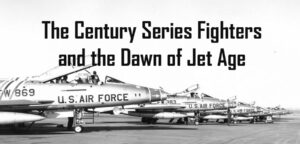
In the shadowed dawn of the Cold War, when the specter of Soviet nuclear bombers cast long fears over American skies, the United States Air Force forged a lineup of aircraft that would etch supersonic supremacy into the annals of military aviation. Collectively dubbed the Century Series, encompassing the F-100 Super Sabre, F-101 Voodoo, F-102 Delta Dagger, F-104 Starfighter, F-105 Thunderchief, and F-106 Delta Dart, these fighters bore designations from F-100 to F-106, a numerical badge of honor reflecting their sequential arrival in the 1950s. Far from a monolithic design effort, the series emerged as a mosaic of parallel innovations, spurred by the raw urgency of geopolitical brinkmanship. Developed amid the Korean War’s sobering lessons and the Eisenhower administration’s “New Look” doctrine of massive nuclear retaliation, these jets transformed the USAF from a force tethered to subsonic constraints into a fleet capable of Mach 1+ dashes that could escort bombers across oceans or scramble to intercept intruders in minutes. Spanning production from 1953 to 1961, over 5,500 airframes thundered off assembly lines, forming the tactical sinew of U.S. air power through crises like the Berlin Blockade and into the quagmire of Vietnam. They were not mere machines, but embodiments of an era’s audacity, where wind tunnels birthed shapes that defied gravity’s grip, and afterburners roared defiance against communist expansion.
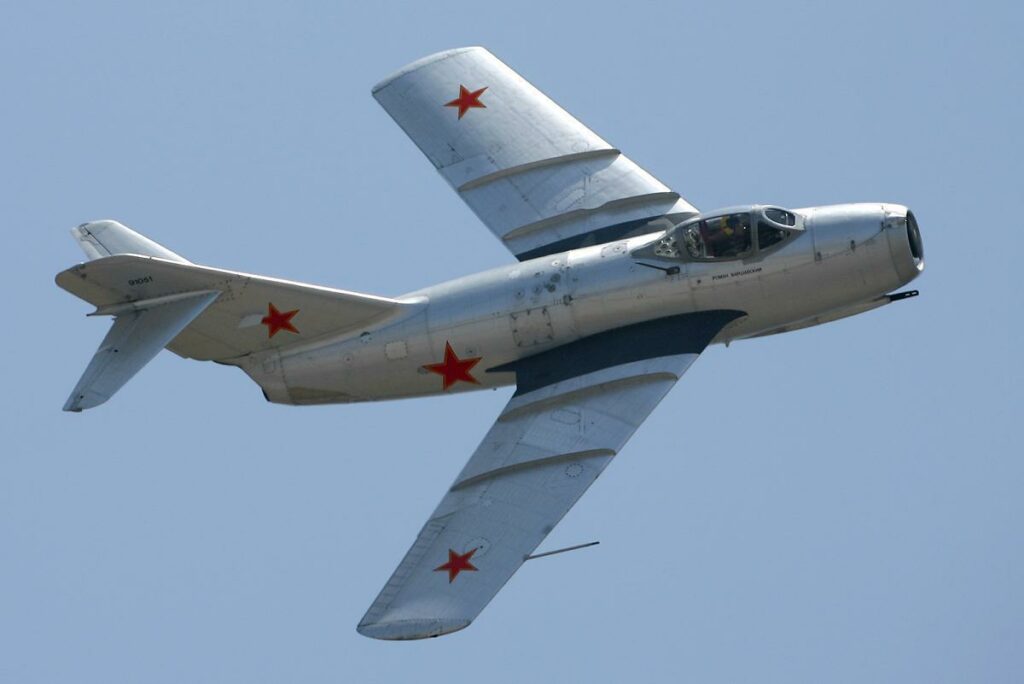
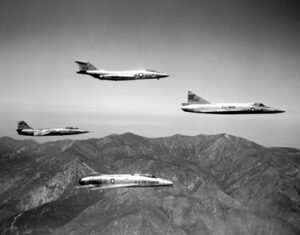 The series’ genesis lay in the crucible of postwar reckoning. Korea had exposed the frailties of early jets: the F-80 Shooting Star and F-84 Thunderjet, with their straight wings and modest thrusts, yielded ground to the MiG-15’s swept-wing agility, costing the USAF hundreds of aircraft despite the F-86 Sabre’s valiant 10:1 kill ratio. As the independent USAF, carved from the Army in 1947, stared down a Soviet arsenal mimicking U.S. B-29s with Tu-4 copies and prototyping long-range heavies, the imperative for speed became existential. By 1951, General Operational Requirements cascaded from the Pentagon, demanding interceptors for Air Defense Command and tactical strikers for Tactical Air Command. This unleashed a contractor frenzy: North American, McDonnell, Convair, Lockheed, Republic, and others vied in a high-stakes derby, greenlit for six concurrent programs under “fly-before-you-buy” edicts. Budgets swelled from $23 million for initial prototypes to billions in aggregate, fueled by letter contracts that prioritized velocity over perfection. The result was a compressed timeline, most from blueprint to squadron in under four years, yielding a heterogeneous brood that shared supersonic DNA but diverged in mission: some pure hunters of the high frontier, others laden bombers blurring lines between fighter and attack roles.
Technologically, the Century Series was a symphony of breakthroughs, harmonizing lessons from X-plane daredevils like the Bell X-1’s 1947 sound-barrier shatter and Convair’s XF-92 delta whispers. Swept wings at 35 to 60 degrees sliced transonic drag, enabling level-flight Mach numbers from 1.2 to 2.0; afterburning axial turbojets (Pratt & Whitney J57s and GE J79s chief among them) surged 10,000 to 24,000 pounds of thrust, their variable inlets gulping stratospheric air for efficiency at 50,000 feet. Armament leaped from .50-caliber guns to radar-homing AIM-4 Falcons and nuclear-tipped AIR-2 Genies, orchestrated by nascent fire-control radars like Hughes’ MG-10 and MA-1, which automated salvos at 50 miles. All-weather radars pierced clouds, inertial navigators plotted arcs over 1,000 miles, and aerial refueling tentacles extended loiter times, while hydraulic boosts and ejection seats armored pilots against 9-g turns. Yet this vanguard paid in blood: accident rates soared to 25 per 100,000 hours due to compressor stalls, pitch instabilities, and titanium-forged heat stresses, grounding squadrons for retrofits such as yaw dampers and area-ruled fuselages. Production crested mid-decade, over 2,000 F-100s alone, but engine failures and material shortages curtailed production, shunting surpluses to Air National Guard wings or to allied exports under the Military Assistance Program.
Operationally, the series knit a tapestry of deterrence and projection, with its jets dispersed across U.S. commands: USAFE squadrons shadowed Warsaw Pact maneuvers in Europe, PACAF units shadowed Red China’s coasts, and CONUS bases like Selfridge manned the Distant Early Warning Line against Arctic incursions. They logged millions of hours, from F-100 low-level nuclear rehearsals to F-106 automated patrols synced to SAGE ground nets, embodying the USAF’s shift to multirole fluidity. In Vietnam, they shouldered 500,000 sorties, bridging rivers with bombs and suppressing radars in Wild Weasel hunts, though ground fire exacted a toll of 800 losses. The series deterred flashpoints (the 1961 Berlin Crisis saw F-101s scramble hourly) while export variants bolstered Taiwan and NATO flanks into the 1980s. Their versatility prefigured the F-4 Phantom’s hegemony, seeding doctrines of integrated air-ground campaigns, yet they illuminated procurement’s thorns: costs ballooned 50-100% per model, from $1 million to $6 million, igniting McNamara-era reforms toward joint buys like the F-111. Phased out by the 1970s (F-100s to museums by 1980, F-106s to NASA testbeds in 1988), the Century Series recedes into lore, a supersonic scaffold for the F-15 and beyond. In an age of stealth and drones, they remind us that air mastery is hammered in haste, where collective daring outran solitary genius.